
Shopify Q1 2026 Shows Why Product Visual QA Matters for AI Commerce
Shopify published its Q1 2026 financial results on May 5, 2026, reporting another quarter of growth and pointing to AI as part of the commerce operating layer. The company said merchants crossed more than $100 billion in quarterly GMV, and Shopify's update highlighted AI-assisted discovery and merchant tooling as active areas of investment.
The practical takeaway extends beyond Shopify stores. AI-assisted shopping increases the number of places where product data and product images may be interpreted before a buyer reaches the PDP. That makes image accuracy, variant consistency, and feed-ready visual assets more important.
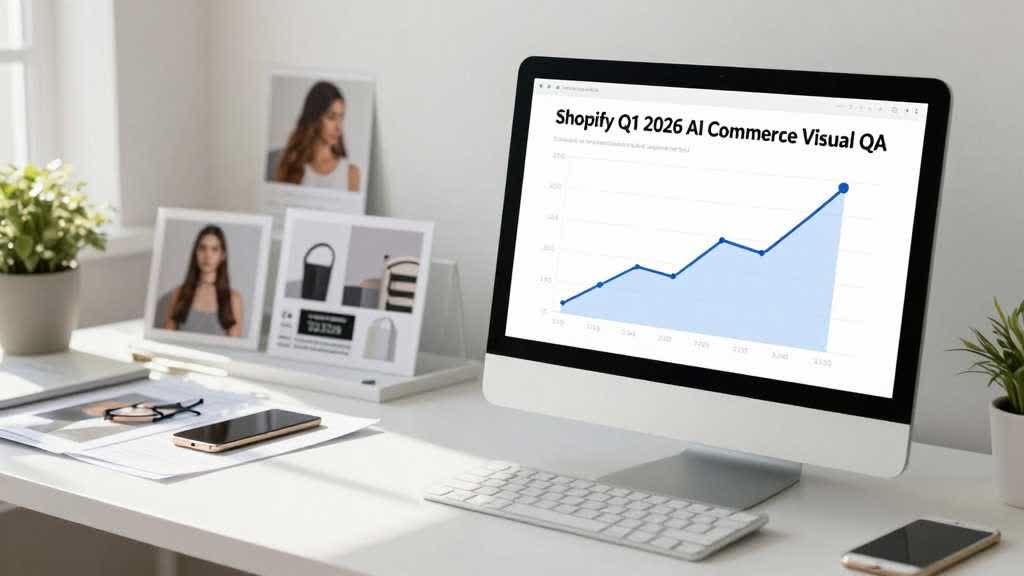
What Changed
Shopify's Q1 2026 release emphasized merchant growth, AI tooling, and the broader shift toward AI-enabled commerce. The company has been investing in tools that help merchants create, sell, and operate faster, while AI shopping behavior is becoming a more visible part of ecommerce discovery.
For sellers, this changes the role of product content. A product image now supports more than the PDP. It may support product feeds, AI shopping answers, search surfaces, comparison flows, ads, storefront cards, and app-driven shopping journeys.
Why Product Visual QA Gets More Important
AI shopping surfaces depend on structured product information and visible product evidence. If the title says one thing, the image implies another, and the PDP clarifies a third, the buyer experience becomes weaker. The same risk appears when a color variant image looks different from the swatch, a lifestyle image implies accessories that are not included, or an enhanced product photo changes material detail.
The issue is practical. AI commerce can make product inconsistencies easier to surface because shoppers ask questions about size, compatibility, color, included parts, use case, and comparison. A weak image set gives the assistant less reliable evidence and gives the buyer more reason to hesitate.
What Ecommerce Teams Should Check
Sellers should review a small group of important SKUs before scaling more AI visuals. Start with products where buyers care about fit, color, compatibility, scale, material, or included parts.
Check:
- whether the main image clearly matches the selected SKU
- whether color variants stay consistent across thumbnails, PDP images, and swatches
- whether AI-generated lifestyle scenes imply unsupported use or extra accessories
- whether product feed images match PDP images
- whether mobile thumbnails still show the difference between variants
- whether A+ or module images support product facts beyond decoration
- whether every generated image can be traced back to a reliable source product photo
These checks also apply to Amazon PDPs, Google Merchant Center feeds, paid ads, product landing pages, and AI-shopping-driven discovery.
A Seller Checklist for the Next 30 Days
A small audit should happen before any full creative rebuild. Pick ten SKUs that already receive traffic or paid clicks. For each SKU, compare the feed image, product-grid image, PDP hero, variant image, lifestyle image, and any AI-generated supporting asset.
| Review area | What to compare | Why it matters |
|---|---|---|
| Main product image | Feed image, PDP hero, product grid thumbnail | AI shopping and search surfaces need a clear SKU reference |
| Variant images | Swatch, selected image, mobile thumbnail | Buyers may choose the wrong color if the selector drifts |
| Lifestyle images | Scene, scale, included props, use case | Scenes can imply accessories or use claims that are not true |
| Product facts | Title, bullet points, specs, image callouts | AI-assisted shopping can expose contradictions quickly |
| Source image quality | Original file, enhanced file, final upload | Weak source files create weak generated assets |
After the audit, create a short visual rule for each category. Apparel needs fit and color discipline. Small electronics need compatibility and included-parts clarity. Beauty needs label and shade accuracy. Home goods need scale and material truth. These rules help teams decide which AI-generated images are safe to publish and which should stay as internal drafts.
What This Means for AI-Generated Product Images
AI-generated product images are becoming more useful, but the review bar is also rising. A generated scene can make a product easier to understand when it answers a buyer question. It becomes risky when it changes color, scale, material, included accessories, compatibility, or product use.
The safest workflow is to separate creative generation from product verification. First, create the visual. Then compare it against the real SKU, approved product data, and the channel where it will appear. The image should survive mobile display, feed compression, PDP zoom, and variant switching.
This is especially important when one source photo becomes the base for many assets. A weak product image can spread into a feed, a PDP module, a paid ad, a lifestyle image, and an AI-shopping answer. Fixing the source image first saves later cleanup.
LoomaDesign workflow for AI commerce image QA
LoomaDesign is useful when a merchant needs to create product visuals without losing product truth. The workflow starts with a source product image, improves quality when needed, creates product-context assets, and keeps QA focused on the SKU.
For today's deeper guides, read Product Image Color Variant QA for Ecommerce if color variants are the risk, and Amazon PDP Image Stack for Small Electronics Accessories if compatibility-heavy products need a stronger PDP image sequence. For the broader foundation, use AI Product Image Generator for Ecommerce to decide where generation fits and Color Correction for Ecommerce Product Images when source color is the weak point.
Questions Sellers Should Ask
Does AI commerce change how product images should be reviewed?
Yes. Product images may be interpreted across feeds, product cards, AI shopping answers, PDPs, and ads. Review images as product evidence as well as creative assets.
Which products should be audited first?
Start with SKUs where buyers rely on color, fit, compatibility, scale, material, or included parts. These are the products where image drift creates the most confusion.
Should every AI-generated image be used on the PDP?
Some images are useful for internal planning, ads, or concept testing but too loose for a PDP. Buyer-facing images should match the real SKU and the product data.
Sources and Data Points
- Shopify, Shopify Q1 2026 financial results
- Shopify News, Millions of merchants can sell in AI chats
- Google Merchant Center Help, Image link attribute