
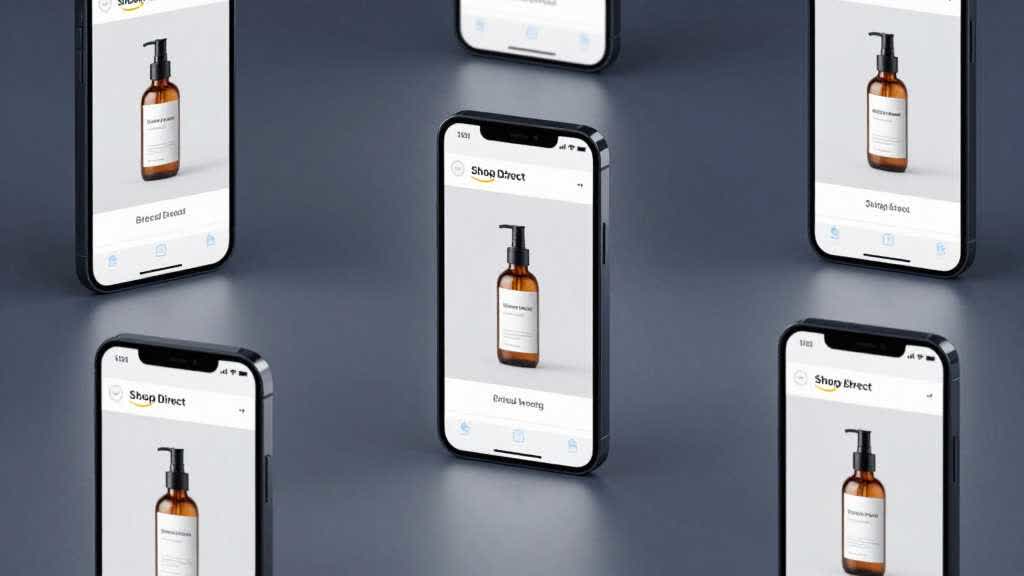
Amazon Shop Direct Feeds Make Product Visual Quality More Important
Amazon has expanded Shop Direct participation by letting merchants connect product catalogs through established third-party feeds, including Feedonomics, Salsify, and CEDCommerce. The update matters because Shop Direct can surface products from stores across the web on Amazon.com, in the Amazon Shopping app, and in Rufus, Amazon's AI shopping assistant.
For ecommerce teams, the practical takeaway is clear: product feeds, product images, and PDP content are becoming part of AI-assisted discovery. A merchant's product information may be evaluated and surfaced outside the merchant's own storefront. That raises the value of clean product data and accurate visual assets.
What Changed
Amazon says merchants can now use feeds they already provide to other partners to sync catalog, pricing, and inventory in real time with Shop Direct. Customers who see Shop Direct products can go to the merchant's store, and for some eligible products, Amazon's Buy for Me experience can complete the purchase on the customer's behalf.
Amazon also says Shop Direct includes more than 100 million products from more than 400,000 merchants. The products can appear in Amazon search experiences and in Rufus, where shoppers ask product questions and compare options through AI-assisted conversations.
This moves product content beyond the classic marketplace listing. A merchant's catalog may need to perform inside a search result, an AI shopping answer, a product comparison, and the merchant's own PDP.
Why Sellers Should Care
Feed-connected commerce depends on consistency. If the product title, image, price, availability, PDP content, and buying experience point in different directions, shoppers can lose confidence quickly. AI shopping assistants may also make product weaknesses more visible because they answer questions, compare options, and surface details that buyers might otherwise search for manually.
That is especially important for product images. A weak main image, mismatched background, low-resolution feed image, or lifestyle image that implies the wrong scale can create doubt before the shopper reaches the merchant site.
The product visual system has to match the product data. The feed names the item. The image shows whether the item looks credible. The PDP gives the buyer enough proof to keep moving.
Product Visual QA Becomes a Feed Problem
Most teams treat product feeds and product images as separate work. Feed managers check title, price, availability, identifiers, and destination URLs. Creative teams check image style. Merchandising teams check PDP layout.
AI-assisted discovery makes those boundaries weaker. A shopper may see a product in a feed-driven placement, ask Rufus for more detail, compare the product with alternatives, and then click to the merchant site. Every step depends on product information staying coherent.
Sellers should review:
- whether the main product image clearly represents the SKU
- whether lifestyle images imply accurate scale and use
- whether product titles match PDP and feed wording
- whether pricing and availability are current
- whether PDP images answer the same buyer questions that AI assistants surface
- whether generated visuals preserve product color, size, label, material, and included parts
The same pressure appears across Google Merchant Center, Shopify product media, marketplace feeds, shopping assistants, and ads. They all depend on product data and visual accuracy staying aligned.
What Ecommerce Teams Should Do Next
Start with a product-content audit. Pick a small set of important SKUs and compare the product feed, main image, gallery images, PDP copy, product facts, and ad assets. Look for mismatches that would confuse a buyer or an AI shopping assistant.
Then create a simple product visual standard. Decide what the main image should show, what secondary images should prove, what lifestyle images are allowed to imply, and what image quality is required before the asset enters a feed or PDP.
For AI-generated images, add one extra review step. The output should be compared against the real product and the product data. If the image changes perceived material, size, included items, or product use, it should not be used as a feed or PDP asset.
The missing review step usually appears at handoff time. A feed manager sees clean rows. A creative reviewer sees acceptable images. A merchandiser sees a reasonable PDP. The buyer sees all three together, and any mismatch becomes obvious.
LoomaDesign workflow for feed-ready images
LoomaDesign's product visual workflow is built around this kind of review. Sellers can create cleaner product visuals, improve weak source images, choose better backgrounds, and plan PDP-ready assets while keeping the image tied to real product facts.
For related guidance, read Amazon PDP Best Practices for Product Images and A+ Content, AI Product Image Generator for Ecommerce, and AI White Background Product Photos.
Amazon's Shop Direct feed expansion gives merchants another reason to keep product content portable across search, stores, feeds, and AI shopping assistants. The same product image may now support more than one surface, so visual QA needs to happen before the feed sends traffic elsewhere.