
On November 3, 2025, Amazon published a detailed seller guide showing how its generative AI tools now support much more than basic listing text. According to Amazon's own walkthrough, sellers can create listing drafts from short descriptions, product images, existing website URLs, spreadsheet uploads, and AI-ready A+ Content modules inside Seller Central.
That matters because Amazon is no longer positioning AI as a side feature. It is turning AI into a core part of the listing and merchandising workflow.
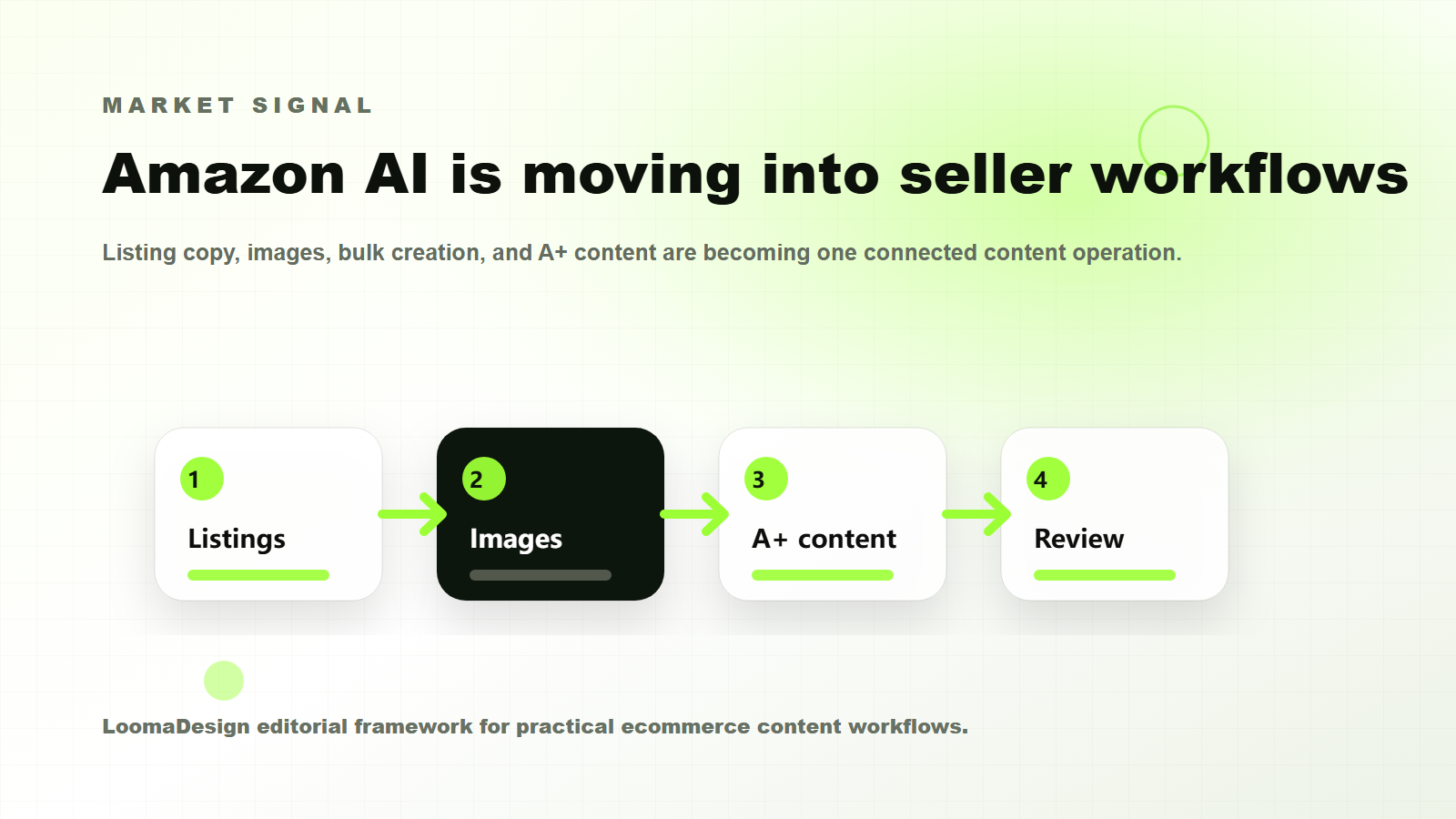
Seller Takeaway: Treat AI as a Content System
The important signal is not that Amazon added another AI feature. The signal is that listing copy, image inputs, bulk creation, and A+ content are starting to behave like one connected seller workflow.
Sellers should respond by improving product facts, visual inputs, and review process. Better inputs will matter more as platform AI becomes more capable.
What happened
In the November 3 update, Amazon outlined two major areas where sellers can use AI:
- Add Products, which supports listing generation from text, images, URLs, and bulk spreadsheet uploads
- A+ Content Manager, which supports AI-assisted text and image creation for A+ modules
Amazon said sellers can use AI to create titles, bullet points, descriptions, and other listing details from minimal input. The company also said its listing AI now generates more than 70% of required product attributes and that sellers using its AI tools see a 40% increase in overall listing quality.
The A+ angle is especially important. Amazon says brands can use AI inside A+ Content Manager to create both text and images for eligible modules, with guidance informed by category insights and top-performing products.
In practical terms, Amazon is moving closer to a single content workflow where the same seller can:
- start with sparse product information
- turn that input into a listing draft
- use AI-ready modules to upgrade the detail page with richer A+ content
- review and edit everything before publishing
Why this matters for ecommerce content teams
For content teams, the biggest shift is not just speed. It is consolidation.
Historically, product copy, listing setup, and A+ creative often lived in separate workflows. A seller might write bullets in one place, brief a designer elsewhere, and then manually rebuild the brand story and feature sections later. Amazon's latest AI workflow reduces the distance between those steps.
That can help in three ways:
1. Faster first drafts across more SKUs
If AI can create usable listing drafts from a website URL or a spreadsheet, catalog teams can get more products into review without starting from a blank page each time.
2. Easier expansion into richer merchandising
Many sellers stop at plain listings because A+ production takes more coordination. By adding AI-ready A+ modules, Amazon is making richer content easier to attempt earlier in the process.
3. Better alignment between listing copy and A+ copy
When both are generated inside the same environment, it becomes easier to keep the product story consistent across titles, bullets, descriptions, and A+ modules.
The real opportunity is operational, not magical
This update does not mean sellers should publish AI drafts untouched. Amazon explicitly says sellers remain responsible for reviewing and editing any proposed content to make sure it is accurate, complete, and compliant with applicable laws and Amazon policies.
That is the key operational takeaway.
The win here is not "AI writes everything for you." The win is that AI can:
- reduce blank-page time
- generate draft structure faster
- surface category-relevant language
- help smaller teams create more content with fewer handoffs
The quality still depends on the review layer.
What content teams should do next
If you sell on Amazon or support brands that do, this announcement is a signal to tighten your content system now.
A practical next step would be to standardize:
- which products can start from AI-generated listing drafts
- which A+ modules your team uses most often
- how reviewers check claims, tone, and module fit
- which prompts or inputs create the cleanest first drafts
The teams that benefit most from Amazon's AI will not be the ones that treat it like a shortcut. They will be the ones that combine faster generation with better internal standards.
Editorial take
This is one of the clearest signs yet that Amazon sees AI-assisted content creation as infrastructure, not just a beta novelty. The company is connecting AI to the actual places sellers already work: listing setup, bulk upload workflows, and A+ Content Manager.
For sellers, that lowers the barrier to publishing richer content. For agencies and aggregators, it raises the bar for how quickly first drafts should be produced.
The competitive advantage now shifts toward teams that know how to edit, structure, and operationalize AI output better than everyone else.
Where This Fits in the Product Detail Page Workflow
Amazon A+ Content is not the whole listing. It is the enhanced-content layer inside the broader Amazon product detail page (PDP). Before a seller writes modules, the page also needs accurate main images, useful secondary images, lifestyle scenes, clean product photos, and product facts that shoppers can trust.
For LoomaDesign, A+ work should connect to the wider product-visual workflow: Amazon listing images, AI product image enhancement, and AI product lifestyle images. Those assets give A+ modules better raw material instead of forcing the modules to carry the whole product story alone.
Source
- Official source: Sell on Amazon - How to use Amazon AI to create product listings