
Amazon AI Shopping Makes Product Image Facts Harder to Ignore
Amazon is moving more shopping behavior into AI-assisted discovery, visual search, and guided comparison. That shift puts more pressure on product images. A shopper may now start with a camera scan, an AI-generated visual idea, a product summary, or a comparison surface before opening a full listing. Sellers cannot treat images as decoration in that environment. The image set needs to prove size, material, color, included parts, use case, and feature differences in a way that both people and shopping systems can read.
The practical response is clear: build product images as evidence, then QA them like listing data.

What Changed in Amazon AI Shopping
Amazon has been expanding visual and AI shopping experiences. Amazon Lens Live scans products in real time and shows matches in a swipeable carousel. Amazon's visual search pages describe image-based shopping as a way to find exact or similar products. Recent coverage of Amazon's AI-generated search visuals also shows how shoppers may use AI-created reference images to narrow what they want before viewing actual products.
That creates a new content problem for sellers. Product pages still need strong titles, bullets, and descriptions, but images now carry more of the first comparison. If the product looks similar to ten others, the image set needs to show the detail that makes it worth choosing.
This is why image facts matter more than style alone.
The Seller Risk: Pretty Images With Weak Evidence
Community discussions around Amazon images reveal a consistent anxiety. Sellers worry about AI images appearing on listings, wrong variation images, image updates not showing, and product visuals that do not match what ships. Buyers complain when AI lifestyle images make a product look better, larger, or more useful than the real item.
Those complaints point to the same operational issue. A product image can be visually polished and still fail the listing if it weakens trust.
For AI shopping and visual search, the risky gaps are specific:
- the main image does not show the exact product
- variation colors look too close or too different
- scale is unclear
- included parts are missing
- material texture is hidden
- lifestyle images imply a use case the product cannot support
- A+ modules repeat claims without visual proof
When shoppers compare quickly, these gaps cost attention. When AI systems summarize or match products, incomplete visual evidence may also make the product harder to interpret.
What Product Images Need to Prove Now
Amazon Ads guidance tells advertisers to feature high-quality images, improve product detail pages, and add A+ Content when possible. Amazon's product image guide recommends a full image set and product visuals that help shoppers inspect the item. The message for sellers is practical: give the shopper enough visual facts before the review section has to do the work.

| Image area | What it should prove | Why it matters |
|---|---|---|
| Main image | exact product, clean crop, accurate color | first recognition and ad click confidence |
| Detail image | material, label, clasp, port, cap, texture, stitching | helps buyers inspect decision details |
| Scale image | size, capacity, fit, package contents | reduces mismatch and return risk |
| Variant image | color, model, size, bundle difference | prevents wrong-variation expectations |
| Use-case image | real setting and credible use | connects feature to buyer need |
| A+ module | benefits backed by visual proof | supports comparison and trust |
| Mobile preview | thumbnail readability | most buyers scan before reading |
This does not mean every product needs a large creative campaign. A small seller can still build a strong set if each image answers one buyer question.
A Practical Workflow for AI Shopping Visibility
I would review the product page in this order.
First, check the main image against marketplace requirements. The product should be clean, centered, large enough in the frame, and accurate to the shipped item. If the supplier image is soft, use an AI product image enhancer only after locking the SKU details.
Second, build the missing proof images. A water bottle may need cap detail, size reference, leak-proof use case, color variants, and included straw. A kitchen organizer may need compartment count, drain base, drawer fit, material close-up, and sink-side context. A skincare set may need pack count, label clarity, texture sample, liquid color, and packaging view.
Third, arrange the page around buyer questions. The Amazon Additional Product Image Generator helps create the support images, while the Amazon PDP and A+ Content Design Tool helps decide where each image belongs in the gallery and A+ sequence.
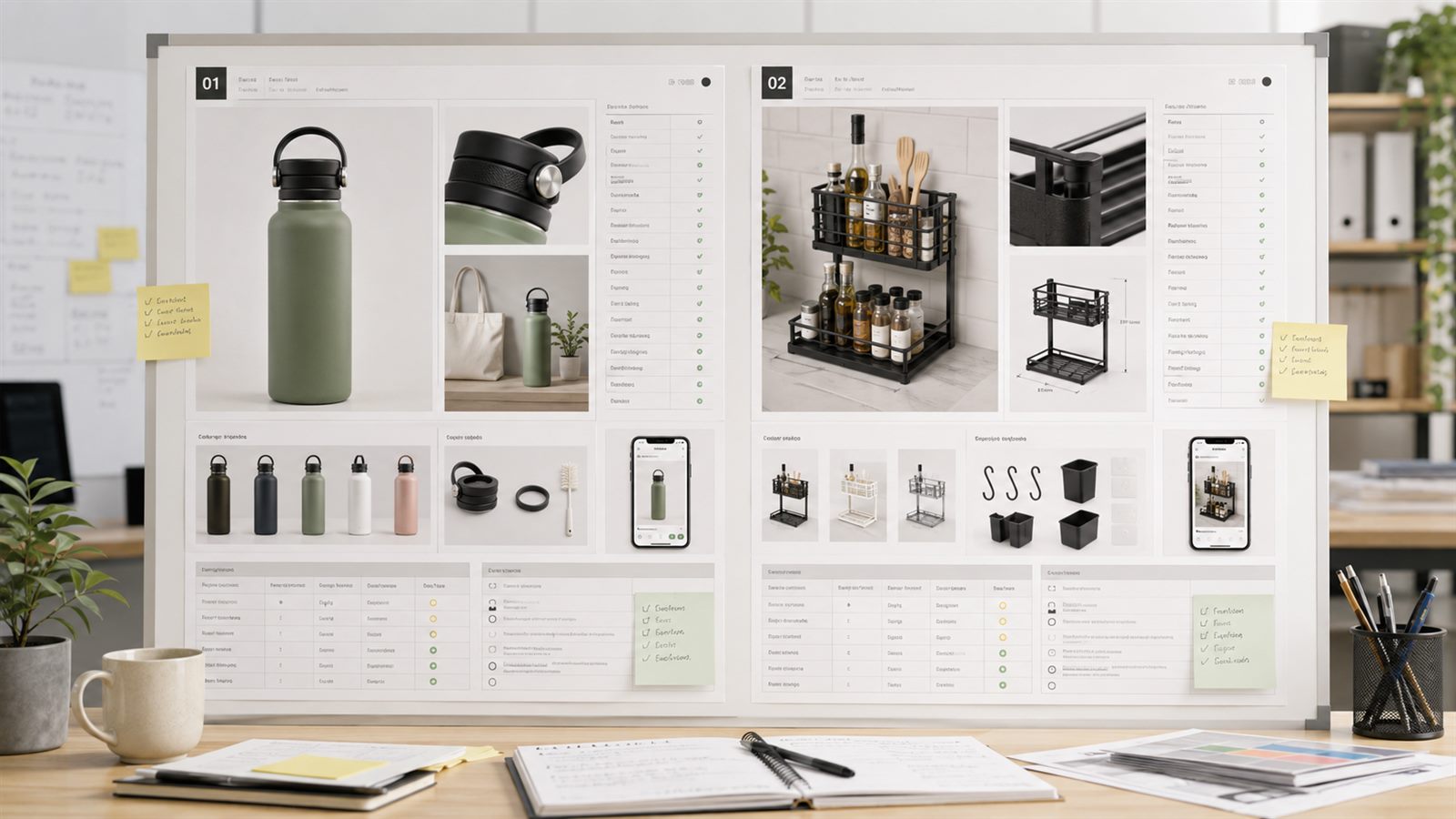
The point is not to flood the page with images. The point is to remove the doubts that block a purchase.
What Sellers Should Watch Next
AI shopping will keep pulling product content into smaller surfaces: camera results, comparison cards, summaries, recommended products, and mobile previews. Sellers should expect product image QA to become closer to data QA. Images need to agree with titles, bullets, attributes, packaging, and real inventory.
The best near-term move is a visual audit of high-traffic SKUs. Start with products that already have ad spend, seasonal demand, or conversion potential. For each product, check whether the gallery answers size, material, included parts, variant differences, use case, and quality proof. Then improve the weak points instead of rewriting the entire listing.

Sources
- https://www.aboutamazon.com/news/retail/search-image-amazon-lens-live-shopping-rufus
- https://www.aboutamazon.com/news/retail/visual-search-shopping-features
- https://advertising.amazon.com/library/guides/improve-your-products-for-advertising
- https://sellercentral.amazon.com/help/hub/reference/external/G1881
- https://techcrunch.com/2026/06/03/amazon-will-show-ai-product-images-when-you-search-for-some-reason/
- https://sellercentral.amazon.com/seller-forums/discussions/t/fab5a9d1-42b2-419c-982d-c5ad16cae3cb